
POLOWACA®

Highland regional spirits

Tradition

Three things the brand grew out of: the hunters who gave it its name, the instrument that called across the pastures, and the ornament that travels on every label.

The polowace

In the highlanders' dialect, polowac described a particular breed of hunter who, through the 18th and 19th centuries, ventured into regions that were then wild and uninhabited, in pursuit of chamois and marmots.

It was often the polowace who first reached the summits of many mountains — climbing where nobody had stood before them, long before the first mountaineers arrived in the Tatras.
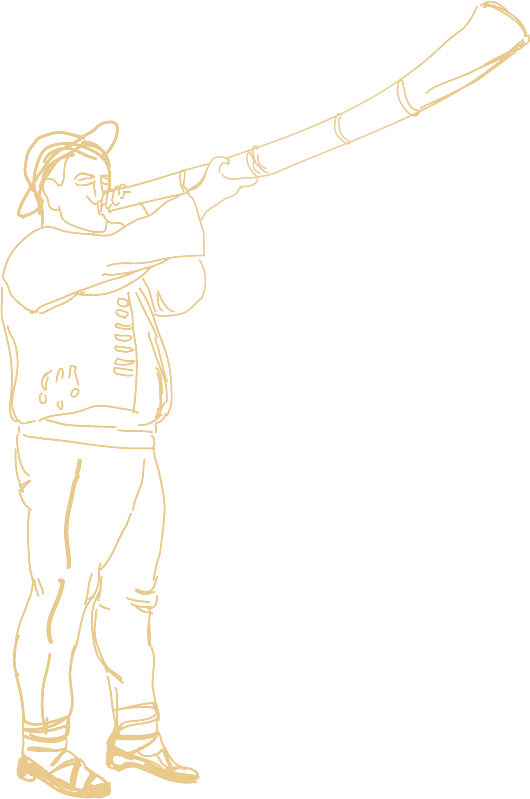
The trombita

Also known as a fujera or fujara, this distinctive wind instrument measures two metres or more. In shape it resembles a wooden pipe flared at the end.

Shepherds used it on the Tatra pastures to warn their herders of danger, and its carrying sound drove off bears. On some evenings highland melodies were played on it in front of the shepherd's hut. Ox traders used it too.

By the end of the 19th century the instrument had fallen entirely out of use across the Tatras and the surrounding region. Today it can be seen in museums — though the tradition of playing it appears to be returning, kept alive by highland music and dance ensembles, now as a stage instrument rather than purely a folk one.

The parzenica

The name of this ornamental element of highland dress probably derives from the dialect words parznąć and parznić — to soil or to stain. It also denoted the wooden moulds used for pressing cheese, and heart-shaped carved decorative motifs.

The pattern is thought to have reached Poland from Hungary. In the second half of the 19th century, parzenice took the form of simple cord loops reinforcing the slits at the front of trousers sewn from heavy broadcloth. Their original purpose was practical: they kept the cloth from fraying.

Early parzenice were of a single colour. The pattern known today is the work of tailors who began embroidering with red or navy cord and multiplied the loops.